You check the listings at midnight after the kids are asleep, do the math three different ways, and still can’t tell if buying a house on one income is even possible. Maybe you’re the only paycheck in the house. Maybe your partner stays home with the kids, or you’re single and raising a family solo. Either way, you’ve probably heard some version of “you need two incomes to buy a house today” — and it’s starting to feel true.
It’s not. Single-income families buy homes every year. It just takes a different playbook than the one built for dual-income households.
Quick Answer: Can a Single-Income Family Buy a House?
Yes. Single-income families can qualify for a mortgage using programs like FHA loans, which allow a 3.5% down payment with a credit score of 580 or higher, according to HUD guidelines. The key is keeping your debt-to-income ratio low, usually under 43%, and choosing a home that fits comfortably within one paycheck instead of stretching for the maximum you’re approved for. The tips below walk through exactly how to make that happen.
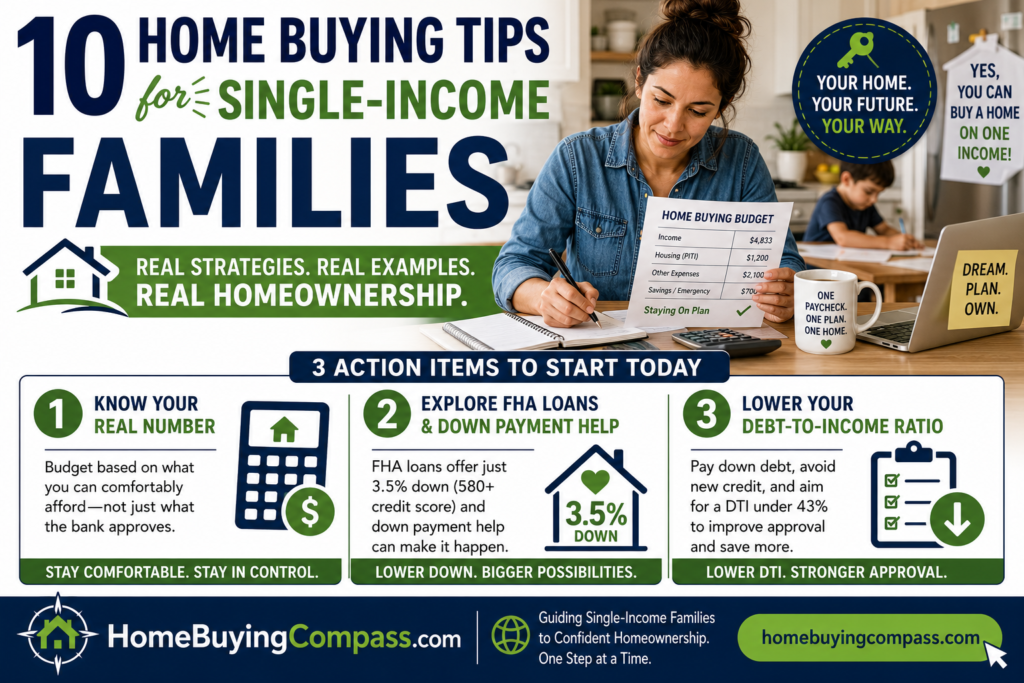
1. Know Your Real Number Before You Know Your Loan Amount
Here’s what most first-time buyers don’t realize: the bank’s approval number and your comfortable number are two different things. A lender might approve you for a $2,400 monthly payment. That doesn’t mean you should spend it.
On a single income, one job loss, one medical bill, or one car repair can hit harder because there’s no second paycheck to absorb the shock. Before you fall in love with a listing, sit down and calculate what you can pay every month without feeling squeezed — then shop for homes at that number, not the bank’s.
Why This Matters
Lenders approve you based on debt-to-income ratio, not on how it will actually feel to live with that payment. Most lenders want your total monthly debts, including the new mortgage, to stay under 43% of your gross income, though the exact cap varies by loan type and lender.
2. Get Familiar With FHA Loans First
This is where many single-income buyers make a costly mistake: they assume they need 20% down and give up before they even apply. In reality, FHA loans were built for buyers exactly in this situation.
With a credit score of 580 or higher, you can qualify for an FHA loan with just 3.5% down. If your score falls between 500 and 579, you can still qualify — you’ll just need 10% down instead, per HUD’s FHA loan guidelines. FHA loans remain one of the most common paths for first-time buyers, though their overall market share has shifted over the years as more buyers explore conventional low-down-payment options.
FHA vs. Conventional: Which Fits a Single Income Better?
| Feature | FHA Loan | Conventional Loan |
| Minimum down payment | 3.5% (score 580+) or 10% (score 500–579) | As low as 3% for qualified first-time buyers |
| Minimum credit score | 500 (with 10% down) | Typically 620+ |
| Mortgage insurance | Required for life of loan (in most cases) | Cancels once you reach 20% equity |
| DTI flexibility | Often more forgiving, up to 43–50% with compensating factors | Usually stricter, closer to 36–45% |
| Best for | Lower credit, smaller savings, single income | Higher credit, some savings, stable income history |
Neither option is “better” across the board. It depends on your credit score, how much you’ve saved, and how flexible your income documentation is.
3. Lower Your Debt-to-Income Ratio Before You Apply
Your debt-to-income ratio, or DTI, compares your monthly debt payments to your monthly income. On one income, this number carries more weight than it does for dual-income households, because there’s no second salary to balance it out.
Most lenders want to see a DTI under 43%, though FHA loans can sometimes stretch higher with strong compensating factors like a solid credit score or extra cash reserves. The Consumer Financial Protection Bureau offers a free calculator to check your own DTI before you apply. The lower your DTI, the more loan options — and better rates — you’ll have access to.
Step-by-Step: How to Lower Your DTI Before Applying
- Pull your full debt list. Add up every monthly payment: credit cards, car loans, student loans, and personal loans.
- Target the smallest balances first. Paying off a small loan entirely removes that payment from your DTI completely, which moves the needle faster than paying down a big balance slowly.
- Pause new credit applications. New credit, even a store card, adds debt and can lower your score right before you need it most.
- Ask about income documentation options. If you have side income, freelance work, or overtime, ask your lender how to document it properly, since consistent extra income can offset a higher DTI.
- Recalculate every 60 days. Debt payoff moves your DTI more than people expect. Track it so you know exactly when you cross into a stronger approval range.
4. Build Your Down Payment Without a Second Income to Lean On
This is where so many single-income families feel stuck longer than they need to. The good news: first-time buyers aren’t putting down 20% anymore. According to the National Association of Realtors’ 2025 Profile of Home Buyers and Sellers, the median down payment for first-time buyers was just 10% — the highest it’s been since 1989. Most of those buyers relied on personal savings (59%), while another 22% received help from relatives or friends as a gift or loan.
That last stat matters. Down payment help from family, when properly documented, is common and accepted by nearly every major loan program.
Where Single-Income Buyers Find Down Payment Help
- State and local down payment assistance programs — many offer grants or forgivable loans specifically for lower- and moderate-income buyers.
- Gift funds from family — allowed on FHA, conventional, and most other loan types with a signed gift letter.
- Employer assistance programs — some employers now offer homebuying grants as a benefit.
- Automatic savings transfers — even $150 a month adds up to $1,800 a year toward closing costs.
5. Meet Maria: A Real Single-Income Homebuyer Story
Maria is a 34-year-old nurse and single mom in Ohio, earning $58,000 a year. She assumed buying a home alone was years away. But after pulling her credit report, she found her score was 612 — enough for an FHA loan.
She spent four months paying off a $2,100 credit card balance, which dropped her DTI from 46% to 39%. Combined with $6,000 in family gift funds and a local down payment assistance grant, she closed on a $185,000 home with 3.5% down. Her mortgage payment ended up $80 less than her old rent.
Maria’s story isn’t rare. It’s what happens when a single-income buyer works the numbers instead of assuming the door is closed.
6. Choose a Payment That Survives a Bad Month
However tempting it is to stretch for a bigger house, this is exactly why so many single-income families end up house-poor. A safer target is keeping your total housing cost, including taxes and insurance, under 28% to 30% of your gross monthly income — even if your lender approves you for more.
This gives you breathing room for the months income dips, a repair comes up, or childcare costs rise unexpectedly.
7. Build a Real Emergency Fund Before Closing
Most lenders like to see reserves, and on a single income, this isn’t optional advice — it’s protection. Aim for at least one to three months of mortgage payments saved separately from your down payment before you close. This fund is what keeps a single missed paycheck from becoming a missed mortgage payment.
8. Consider a Co-Signer or Co-Borrower Carefully
Some single-income buyers bring in a parent or sibling as a co-signer to strengthen their approval odds. This can work, but it also means that person is legally responsible for the loan if payments are missed. Have an honest conversation about expectations before you add anyone to the application, so it strengthens the relationship instead of straining it.
9. Get Pre-Approved, Not Just Pre-Qualified
Pre-qualification is a quick estimate. Pre-approval involves a lender actually verifying your income, credit, and documents. On a single income, sellers and agents take pre-approved buyers far more seriously, because there’s no second income to raise questions about.
10. Work With a Lender Who Understands Non-Traditional Income
If your income includes overtime, bonuses, freelance work, or child support, find a loan officer experienced with single-income and non-traditional income documentation. The right lender can often find ways to count income that a less experienced one might overlook entirely.
Common Mistakes Single-Income Buyers Make
- Assuming they need 20% down before even applying. Most first-time buyers put down far less.
- Applying for new credit cards or car loans right before house hunting. This can lower your score and raise your DTI at the worst possible time.
- Skipping the emergency fund to stretch for a bigger down payment. This leaves zero cushion for the first year of homeownership.
- Not asking about down payment assistance programs. Many buyers never apply simply because they didn’t know these programs existed.
- Choosing the maximum approved payment instead of a comfortable one. The bank’s number and your number aren’t the same thing.
You’re Closer Than You Think
Buying a home on one income takes more planning than doing it with two, but it is not out of reach. Every step above — lowering your DTI, exploring FHA loans, building reserves, and shopping for a payment that fits your real life — moves you closer to a set of keys that are actually yours.
Start with one step this week: pull your credit report, calculate your real DTI, or look up down payment assistance programs in your state. Homeownership on a single income isn’t a someday goal. For families like Maria’s, it’s already done.
FAQ Section
Can I get approved for a mortgage on one income? Yes. Lenders approve mortgages based on your debt-to-income ratio and credit score, not the number of incomes in your household. Many single-income buyers qualify using FHA loans or conventional low-down-payment programs.
How much income do I need to buy a house alone? There’s no fixed number — it depends on home price, debt, and interest rates. A common guideline is keeping your total housing payment under 28% to 30% of your gross monthly income.
What credit score do I need for an FHA loan? A score of 580 or higher qualifies for the FHA’s minimum 3.5% down payment. Scores between 500 and 579 require at least 10% down, according to HUD guidelines.
Can family gift money count toward my down payment? Yes. Most loan programs, including FHA and conventional loans, allow gift funds from family members with a signed gift letter documenting the source.
What debt-to-income ratio do I need as a single-income buyer? Most lenders prefer a DTI under 43%, though this varies by loan program. Paying down existing debt before applying is one of the fastest ways to improve it.
Is it harder to get approved as a single applicant versus a married couple? Not inherently. Lenders evaluate your individual income, credit, and debt — not your marital status. What matters is whether your numbers support the loan you’re requesting.