You’re lying awake at 11 p.m., phone in hand, typing “am I ready to buy a house” into Google for the third night this week. Sound familiar? You’re not behind. You’re not doing this wrong. You’re just missing a clear checklist — and that’s exactly what this is.
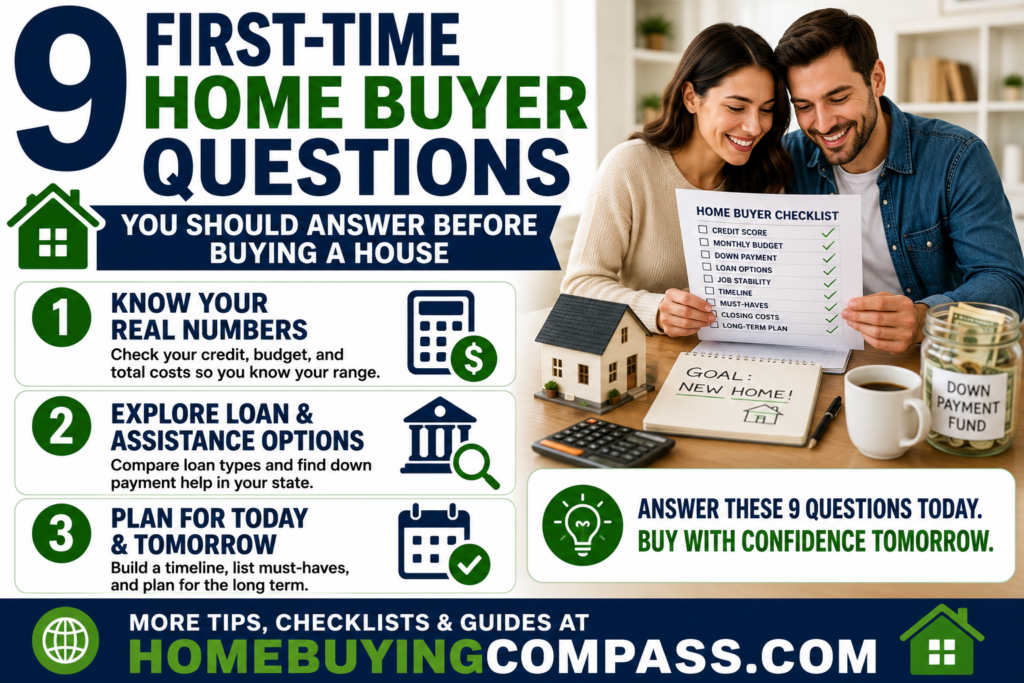
Quick Answer: Before buying a house, you need to answer nine questions: your credit score tier, your real monthly budget, your down payment source, your loan type, your job stability, your timeline, your must-haves vs. nice-to-haves, your closing cost cushion, and your long-term plan for the home. Answer these honestly and you’ll walk into the process with confidence instead of guesswork.
Here’s what most first-time home buyers don’t realize: the paperwork isn’t the hard part. The hard part is figuring out what you actually want and can afford before a lender, agent, or seller starts moving fast around you. So let’s slow down and go through it together.
1. What’s My Real Credit Score — Not the One I’m Guessing At?
Your credit score decides which doors are even open to you, so this is where everything starts.
- 580 or higher: You qualify for an FHA loan with just 3.5% down.
- 500–579: FHA is still possible, but you’ll need 10% down.
- 620 or higher: You’re in range for most conventional loans.
Interestingly, the average score for people who actually get approved for an FHA loan sits around 686 — well above the minimum. That doesn’t mean you need a perfect score. It means most successful buyers aren’t scraping by at the floor, so a little credit cleanup now can save you real money later.
2. Can I Actually Afford the Monthly Payment — Not Just the Down Payment?
This is where many buyers make a costly mistake. They save aggressively for a down payment and forget that the monthly payment includes way more than principal and interest.
Your true monthly cost includes:
- Principal and interest
- Property taxes
- Homeowners insurance
- Mortgage insurance (if your down payment is under 20%)
- HOA fees, if applicable
Meet Danielle, a 29-year-old nurse in Ohio. She’d saved $18,000 and felt ready. But when her lender added taxes and insurance to her estimate, her “affordable” $1,750 payment jumped to $2,180. She didn’t back out — she just adjusted her price range by $30,000 and found a home that actually fit her real budget, not her hopeful one.
3. Where Is My Down Payment Actually Coming From?
Down payment assistance programs are one of the least-known tools in home buying, and that’s exactly why so many people stay stuck renting longer than they planned.
There are over 2,600 down payment assistance programs across the U.S., and the average benefit is around $18,000 — often enough to cover most or all of a modest down payment. Sources can include:
- Personal savings
- A gift from family (must be documented)
- State or local down payment assistance programs
- Employer homebuyer benefits
- Retirement account withdrawals (talk to a tax professional first)
4. FHA, Conventional, or Something Else? Comparing Your Loan Options
This is usually the most confusing question, so let’s make it simple with a side-by-side look.
| Loan Type | Minimum Credit Score | Minimum Down Payment | Best For |
| FHA | 580 (500 with 10% down) | 3.5% | Lower credit scores, smaller savings |
| Conventional | 620 | 3–5% | Stronger credit, avoiding some FHA fees |
| VA | No official minimum | 0% | Eligible veterans and service members |
| USDA | Around 640 typical | 0% | Eligible rural and suburban areas |
Each option trades off differently between upfront cost and long-term cost, so the “best” loan depends on your specific number, not a general rule.
5. Is My Job Stable Enough to Qualify?
Lenders look at two years of income history and want to see consistency, not perfection. Job changes within the same field are usually fine. Frequent industry-hopping or unexplained employment gaps can slow things down, so it’s worth having a simple explanation ready if your history is anything but a straight line.
6. What’s My Realistic Timeline?
Buying a house is rarely a 30-day sprint. Between credit prep, saving, house hunting, and closing, a realistic first-time timeline runs three to twelve months. Rushing this step is how buyers end up settling for a home that doesn’t actually fit their life.
7. What Are My True Must-Haves vs. Nice-to-Haves?
Write two lists before you ever step into an open house. One for absolute must-haves — commute distance, number of bedrooms, safety. One for nice-to-haves — a finished basement, a specific style of kitchen. This one step alone prevents most of the emotional overspending that happens mid-search.
8. Do I Have Enough Cushion for Closing Costs?
Closing costs typically run 2% to 5% of the loan amount, according to the Consumer Financial Protection Bureau. On a $350,000 home, that’s roughly $7,000 to $17,500 — on top of your down payment. This is exactly why so many first-time buyers get caught off guard at the finish line.
9. What’s My Plan If Life Changes in the Next Five Years?
A house is a five-to-ten-year decision disguised as a 30-year loan. Job changes, growing families, and relocations happen. Before you buy, ask yourself honestly: could I rent this home out, sell it without losing money, or make it work if my income temporarily dropped? If the answer is yes to at least one, you’re in a much safer position.
Your Step-by-Step Action Plan
- Pull your credit report and identify your score tier.
- Calculate your full monthly payment, not just principal and interest.
- Research down payment assistance programs in your state.
- Compare FHA, conventional, VA, or USDA based on your numbers.
- Get pre-approved with at least two lenders to compare offers.
- Build your must-have and nice-to-have lists.
- Save a dedicated closing cost cushion separate from your down payment.
- Talk to your agent about a realistic, unhurried timeline.
Common Mistakes First-Time Buyers Make
- Shopping before getting pre-approved, then falling in love with a home outside their real range.
- Draining every dollar of savings for the down payment and having nothing left for closing costs or moving expenses.
- Ignoring lender overlays — some lenders require a 620+ score even on FHA loans, so getting rejected by one doesn’t mean you’re rejected everywhere.
- Skipping the home inspection to make an offer more competitive, then facing expensive surprises later.
- Making large purchases or opening new credit between pre-approval and closing, which can jeopardize final loan approval.
You’re Closer Than You Think
Buying a house feels overwhelming for almost everyone the first time — that feeling doesn’t mean you’re unprepared, it means you’re paying attention. Answer these nine questions honestly, and you’ll walk into your first showing with something most buyers don’t have: real clarity.
You don’t need to have it all figured out today. You just need the next right step. Start with your credit report, and let the rest follow.
FAQ
How much money do I actually need saved before buying a house? Plan for your down payment (3.5%–20% depending on loan type) plus 2%–5% of the loan amount for closing costs, plus a small cash cushion for moving and immediate repairs.
What credit score do I need to buy a house? 580 for an FHA loan with 3.5% down, or 620 for most conventional loans — though many lenders set their own, higher requirements.
How long does it take to buy a house as a first-time buyer? Most first-time buyers take three to twelve months from starting credit prep to closing day, depending on savings, market conditions, and how quickly the right home appears.
Is it better to get an FHA loan or a conventional loan? FHA loans generally help buyers with lower credit scores or smaller down payments, while conventional loans can cost less over time for buyers with stronger credit — the right one depends on your specific financial picture.
Can I buy a house with no down payment? Yes, if you qualify for a VA loan (eligible service members and veterans) or a USDA loan (eligible rural and suburban properties). Most other loan types require some down payment.
What’s the biggest mistake first-time home buyers make? Shopping for homes before getting pre-approved, which often leads to falling in love with a home outside their actual budget.
For official guidance on loan programs and requirements, see HUD and the Consumer Financial Protection Bureau.