You run your own business. You worked hard to build it. And now, when it’s time to buy a house, it feels like your income “doesn’t count” the same way a regular paycheck does.
That fear is real. Millions of self-employed Americans hit this same wall every year. But here’s the good news: FHA loans were practically made for people like you.
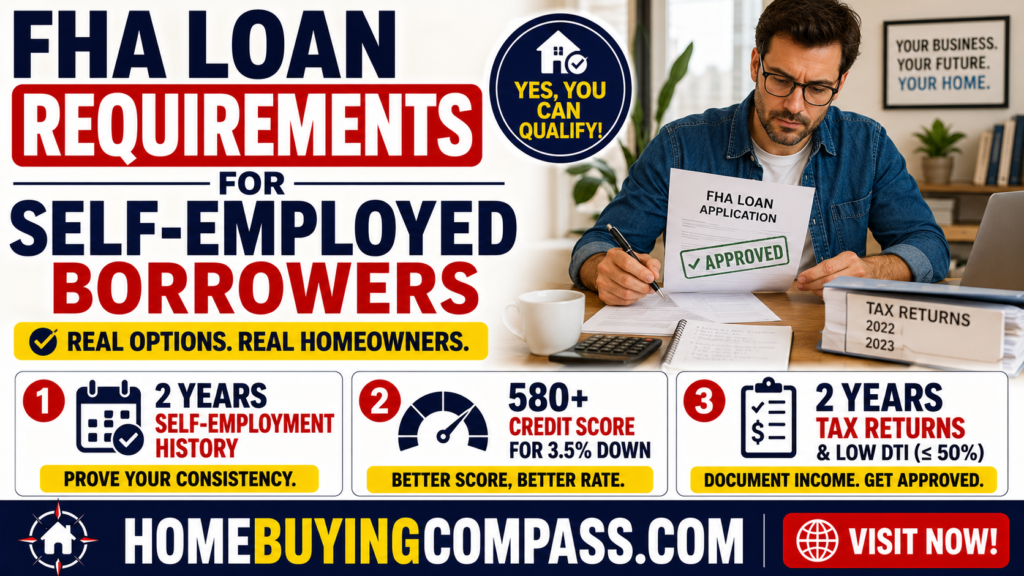
Quick Answer: To qualify for an FHA loan as a self-employed borrower, you typically need at least 2 years of self-employment history, a minimum credit score of 580 (for the 3.5% down payment option), a debt-to-income ratio under 43-50%, and two years of tax returns showing stable or growing income. Lenders average your income over those two years rather than judging you on one slow month.
That’s it. That’s the core answer. Now let’s break down exactly what that means for your specific situation — because the details matter more than the headline.
Why Self-Employed Buyers Feel So Anxious About Mortgages
Here’s what most first-time home buyers don’t realize: lenders aren’t scared of self-employment. They’re scared of unpredictable income.
If you’re a W-2 employee, your pay stub tells the whole story. If you’re self-employed, your income lives across tax returns, bank statements, and business deductions. That takes more paperwork to prove — not more risk to disprove.
This is exactly why so many self-employed buyers stay stuck renting longer than they planned. They assume they’ll get rejected before they even apply. Often, that assumption is wrong.
What Counts as “Self-Employed” for an FHA Loan?
The FHA and most lenders consider you self-employed if you own 25% or more of a business. This includes:
- Sole proprietors and freelancers
- 1099 independent contractors
- LLC owners and partners
- S-corp and C-corp owners with significant ownership
- Gig workers with consistent contract income
If you own less than 25%, some lenders may treat your income more like traditional employment income, which can simplify things.
Core FHA Loan Requirements for Self-Employed Borrowers
This is where many buyers make a costly mistake — they assume the requirements are completely different from a regular FHA loan. They’re not. You just need to document your income differently.
1. Two Years of Self-Employment History
Lenders generally want two years of tax returns from the same business or the same line of work. This proves your income is a pattern, not a fluke.
There’s an exception, though. If you have at least one year of self-employment plus two years of prior experience in the same field as an employee, some lenders will consider that.
2. Minimum Credit Score
- 580 credit score — qualifies you for the 3.5% down payment option
- 500-579 credit score — still possible, but requires 10% down
According to the Federal Housing Administration, FHA loans exist specifically to make homeownership accessible to buyers who don’t fit the “perfect borrower” mold. That includes you.
3. Debt-to-Income Ratio (DTI)
Your DTI compares your monthly debt payments to your monthly income. FHA guidelines generally allow:
- Up to 43% DTI for straightforward approval
- Up to 50% DTI with compensating factors like strong credit or cash reserves
4. Two Years of Tax Returns (Personal and Business)
This is the big one. Lenders use your net income (after deductions), not your gross revenue. So if your business shows big write-offs, your qualifying income may look lower than your actual lifestyle income.
This is often the moment self-employed buyers feel discouraged. But there’s a fix, and we’ll get to it below.
5. A Signed Letter From Your CPA or Tax Preparer
Many lenders request a letter confirming your business is still active and operating. It sounds intimidating, but it’s usually a five-minute request for your accountant.
Real Example: How Maria Qualified as a Freelance Graphic Designer
Maria had been freelancing for three years, earning around $68,000 annually. But her tax returns showed only $41,000 in net income after deductions for her home office, software, and equipment.
At first, she panicked. She assumed she wouldn’t qualify for anything close to the home she wanted.
Instead, her loan officer averaged her last two years of net income, factored in a consistent upward trend, and helped her document a few “add-back” expenses like depreciation. As a result, Maria qualified for an FHA loan with a $290,000 purchase price — and closed in just under 45 days.
Her lesson? The number on your tax return isn’t always the final word. How you present it matters.
Step-by-Step: How to Prepare Your FHA Loan Application
- Gather two years of personal and business tax returns, including all schedules (Schedule C, K-1, or 1120S depending on your business type).
- Pull your credit report early and dispute any errors before applying — this can take 30-45 days to resolve.
- Organize profit-and-loss statements, ideally prepared by a CPA or bookkeeper, covering the most recent 12 months.
- Separate personal and business bank accounts, if you haven’t already — mixed accounts slow down underwriting significantly.
- Calculate your average net income over the past two years to estimate your qualifying income.
- Get pre-approved with an FHA-experienced lender who works with self-employed borrowers regularly, not occasionally.
- Avoid large purchases or new credit in the 3-6 months before applying, since this can shift your DTI unexpectedly.
- Submit your application with a clean, organized document package — this alone can shave weeks off your approval timeline.
FHA Loans vs. Conventional Loans for Self-Employed Buyers
| Factor | FHA Loan | Conventional Loan |
| Minimum credit score | 580 (3.5% down) | 620 typically |
| Down payment | 3.5% – 10% | 3% – 20% |
| DTI flexibility | Up to 50% with factors | Usually capped near 45% |
| Self-employment history | 2 years standard | 2 years standard |
| Mortgage insurance | Required, often for life of loan | Can be removed at 20% equity |
| Best for | Lower credit, smaller down payment | Higher credit, long-term savings |
Neither option is “better” universally. It depends on your credit profile, savings, and long-term plans.
Common Mistakes Self-Employed Borrowers Make
- Writing off too much before applying. Reducing your tax bill also reduces your qualifying income. Talk to your CPA about this trade-off a year before you plan to buy.
- Switching business structures right before applying. Moving from sole proprietor to LLC can reset your income history in a lender’s eyes.
- Mixing personal and business expenses. This creates confusion during underwriting and raises red flags.
- Applying with only one year of returns. Without the required history or a strong exception case, this almost always causes delays or denial.
- Ignoring credit score improvements. Even a 20-point increase can change your down payment requirement significantly.
Why This Actually Works in Your Favor
Here’s the truth: FHA loans were designed to widen the door to homeownership, not narrow it. According to the Consumer Financial Protection Bureau, FHA loans consistently help buyers with lower credit scores and smaller down payments become homeowners when conventional financing feels out of reach.
Self-employment isn’t a weakness in this process. It just requires a different kind of proof.
You’re Closer to This Than You Think
Buying a house feels overwhelming for almost everyone, especially when your income doesn’t fit into a neat little box. But thousands of self-employed people qualify for FHA loans every single year — freelancers, contractors, small business owners, and solo entrepreneurs just like you.
The difference between staying stuck and getting the keys often comes down to preparation, not eligibility. Start gathering your documents. Talk to a lender who actually understands self-employed income. And give yourself permission to believe this is possible — because for so many people just like you, it already has been.
FAQ: FHA Loans for Self-Employed Borrowers
Can I get an FHA loan with only one year of self-employment? Sometimes, if you have two years of related work experience in the same field before going self-employed. Documentation requirements are stricter in this case.
Do FHA loans require tax transcripts? Yes. Lenders typically request IRS tax transcripts (Form 4506-C) to verify your returns match what you submitted.
What if my business income dropped last year? A significant decline can hurt approval odds. Lenders want to see stable or increasing income, so be prepared to explain any dip with documentation.
Can I use bank statements instead of tax returns? Standard FHA loans require tax returns. However, some non-QM lenders offer bank statement loans, which are a separate loan type with different terms.
How much house can I actually afford as a self-employed buyer? This depends on your average net income, current debts, and local home prices. A lender can calculate this precisely once you provide two years of returns.
Does an LLC or S-corp change my FHA eligibility? Not necessarily, but it changes how your income is documented. K-1s and business tax returns come into play alongside your personal return.