You found a house you love. Then you did the math, and your stomach dropped.
Maybe your loan officer mentioned something about “loan limits,” and now you’re wondering if the home of your dreams is even allowed under an FHA loan. If you’ve felt that jolt of panic — the one where excitement turns into “wait, can I even afford to try?” — you’re not alone. Thousands of first-time buyers hit this exact wall every year.
Here’s the good news: FHA loan limits went up in 2026, and understanding them is a lot simpler than it sounds.
Quick Answer: 2026 FHA Loan Limits
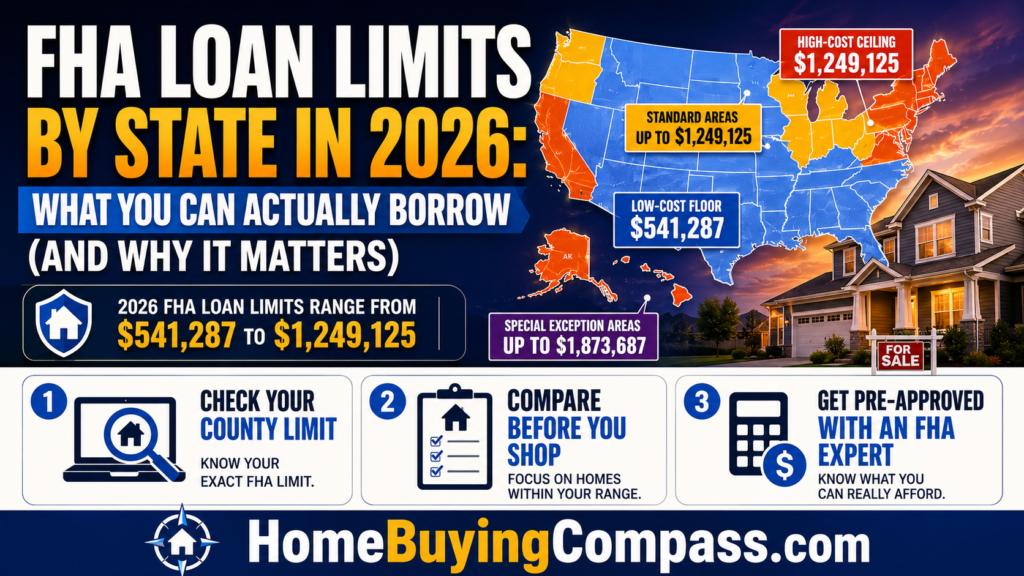
For 2026, the FHA loan limit for a single-family home ranges from $541,287 in most counties (the “floor”) up to $1,249,125 in high-cost areas like parts of California, New York, and Hawaii (the “ceiling”). Some special exception areas, including Alaska and Hawaii, can go as high as $1,873,687. Your exact limit depends on your county, not your state as a whole, so two neighboring counties can have very different caps.
That’s the headline. Now let’s break down what it actually means for you, your budget, and your path to owning a home.
Why FHA Loan Limits Even Exist
FHA loans are backed by the federal government through the Federal Housing Administration, which is part of the U.S. Department of Housing and Urban Development (HUD). Because taxpayers are essentially co-signing the risk, HUD caps how much can be borrowed in any one area.
Every year, HUD recalculates these limits based on how much home prices moved nationally. So when home prices rise, your borrowing power usually rises with them. That’s exactly what happened this year.
How the 2026 Numbers Were Calculated
HUD sets FHA limits using a formula tied to the conforming loan limit, which is the cap set separately for conventional loans by the Federal Housing Finance Agency (FHFA). For 2026, that conforming baseline is $832,750.
From there, HUD applies two key percentages:
- The floor is set at 65% of the conforming limit, which equals $541,287. This applies to most counties in the country, especially in the Midwest, the South, and rural areas.
- The ceiling is set at 150% of the conforming limit, which equals $1,249,125. This applies to expensive metro areas where home prices run well above the national average.
This is up roughly 3.26% from 2025, when the floor sat at $524,225. In plain terms, that’s about $17,000 more borrowing power for buyers in lower-cost counties, and nearly $40,000 more in high-cost markets.
Why This Matters More Than You Think
Here’s what most first-time home buyers don’t realize: this limit isn’t the amount you’re approved for. It’s the maximum amount the FHA program will insure. Your actual approval still depends on your income, debt, and credit score.
But if a home’s price sits above your county’s FHA limit, an FHA loan simply won’t cover it, no matter how strong your finances look. And this is exactly why so many buyers get their hearts set on a home, only to discover it’s out of reach for the loan type they were counting on.
Knowing your limit before you start house hunting saves you from that heartbreak entirely.
FHA Loan Limits by Area Type: A Quick Comparison
| Area Type | 2026 Single-Family Limit | Where This Applies |
| Low-cost (floor) | $541,287 | Most U.S. counties, including much of the Midwest, South, and rural regions |
| Standard/moderate | Between $541,287 and $1,249,125 | Mid-size metro areas with above-average home prices |
| High-cost (ceiling) | $1,249,125 | Parts of California, New York, Massachusetts, Colorado, and Washington |
| Special exception areas | Up to $1,873,687 | Alaska, Hawaii, Guam, and the U.S. Virgin Islands |
Multi-unit properties (duplexes, triplexes, and fourplexes) have their own, higher limits in every category, since you’re financing more than one living unit under one loan.
A Real Example: Meet Danielle
Danielle is a 29-year-old nurse in Columbus, Ohio, buying her first home on a $58,000 salary. Her county’s FHA limit for 2026 sits right at the national floor of $541,287.
She found a $310,000 starter home, well under her county’s cap, so an FHA loan was a realistic option. With a 3.5% down payment, she needed just $10,850 upfront, plus closing costs.
Compare that to her cousin Marcus, who’s house hunting in San Diego, where the FHA limit for his county is closer to $1,000,000. A $310,000 home barely exists there. Marcus has to think about the FHA limit differently, because in his market, the ceiling matters far more than the floor.
Same loan program. Two completely different realities. This is why state-level averages can be misleading, and county-level numbers are what actually count.
How to Find Your Exact County Limit
- Go to HUD’s official lookup tool at hud.gov and search “FHA mortgage limits,” or visit the direct lookup portal your lender provides.
- Select the current year (2026) and the FHA Forward Mortgages program.
- Enter your state, then your county. Limits are set per county, not per state, so don’t skip this step.
- Note the limit for your property type (1-unit, 2-unit, 3-unit, or 4-unit), since they’re all different.
- Compare that number to homes you’re considering before you fall in love with one that’s out of range.
- Ask your lender to confirm it during pre-approval, since limits occasionally get updated mid-year in rare cases.
Doing this before you start browsing listings will save you hours of disappointment later.
FHA Loan Limits vs. Conventional Loan Limits
A lot of buyers assume FHA and conventional loans work the same way. They don’t, and the differences matter for your approval odds.
| Factor | FHA Loan | Conventional Loan |
| Minimum credit score | 580 for 3.5% down | Typically 620+ |
| Minimum down payment | 3.5% | 3–5% |
| 2026 low-cost limit | $541,287 | $806,500 |
| 2026 high-cost limit | $1,249,125 | $1,209,750 |
| Mortgage insurance | Required for life of most loans | Can be removed at 20% equity |
FHA loans tend to be easier to qualify for if your credit isn’t perfect yet, but conventional loans often win in expensive markets and once you’ve built stronger credit. Neither one is “better” across the board. It depends on your numbers.
Common Mistakes First-Time Buyers Make
Assuming the limit is the same everywhere in their state. Buyers in one county often assume the neighboring county shares the same cap. It rarely does, especially near state lines or in states with both rural and metro counties.
Confusing the loan limit with their personal borrowing power. The FHA limit is a ceiling, not a guarantee. Your income, debt-to-income ratio, and credit score still determine your actual approval amount.
Waiting until after an offer to check the limit. By then, you’ve already emotionally attached to a house. Checking early protects your budget and your heart.
Forgetting multi-unit limits exist. Buyers exploring house-hacking with a duplex often don’t realize the limit is significantly higher than the single-family cap, and miss out on a strategy that could’ve worked for them.
Not asking about down payment assistance. Many buyers assume FHA loans are their only option for low-money-down buying, without realizing state and local down payment assistance programs can stack with FHA loans to reduce upfront costs even further.
What This Means for Your Home Buying Journey
If you’ve been feeling stuck, wondering whether homeownership is even realistic on your income, this update is genuinely good news. Higher limits mean more homes are within reach of the FHA program, especially in mid-priced markets where prices crept up over the last year.
That said, a bigger limit doesn’t mean you should stretch to the maximum. Just because you can borrow up to your county’s cap doesn’t mean you should. A trusted lender can help you find the number that fits your real life, not just the number FHA allows.
The path from renter to homeowner rarely feels simple. But understanding exactly how much home you can access, county by county, is one of the biggest steps toward making that path feel possible instead of impossible.
The Bottom Line
Buying your first home comes with a hundred small anxieties, and loan limits shouldn’t be one of them anymore. You now know the floor, the ceiling, and exactly where to check your own county’s number before you shop.
Take five minutes today to look up your county’s 2026 FHA limit. Then talk to a lender about what you can realistically qualify for within that range. That single step turns a vague dream into an actual plan, and that shift is worth everything.
Frequently Asked Questions
Do FHA loan limits vary by state, or by county? FHA loan limits are set by county (or metropolitan area), not by state. Two counties in the same state can have very different limits depending on local home prices.
What is the maximum FHA loan amount for 2026? The maximum for a standard single-family home is $1,249,125 in high-cost counties. Special exception areas like Alaska and Hawaii can go up to $1,873,687.
What credit score do I need for an FHA loan in 2026? You typically need a credit score of at least 580 to qualify for the standard 3.5% down payment. Scores between 500 and 579 may still qualify, but usually require a 10% down payment.
Can FHA loan limits change during the year? They can, though it’s rare. HUD sets limits annually based on the National Housing Act formula, but occasionally issues mid-year adjustments if data warrants it. Always confirm the current figure with your lender.
Are FHA loan limits different for multi-unit properties? Yes. Duplexes, triplexes, and fourplexes all have higher FHA limits than single-family homes, since the loan covers multiple living units.
Does a higher FHA loan limit mean I’ll qualify for more? Not necessarily. The FHA limit is the maximum the program will insure in your area. Your personal approval amount still depends on your income, debt-to-income ratio, and credit history.
Where can I find the official FHA loan limit for my county? You can search HUD’s official lookup tool directly at hud.gov, or ask your lender to confirm it during pre-approval.
Is an FHA loan still a good option if my county’s limit is low? Often, yes. Most counties sit at the national floor of $541,287, which still covers the vast majority of starter homes across the U.S. FHA loans remain one of the most accessible paths to homeownership for buyers with limited savings or developing credit.