You check your savings account. Then you check home prices in your area. Then you sigh and close the tab, convinced homeownership is something that happens to other people.
If that sounds familiar, take a breath. You’re not behind — you just haven’t seen the full picture yet. Millions of people buy homes every year with far less saved up than they think they need, and there are real, legitimate programs built specifically to make that possible.
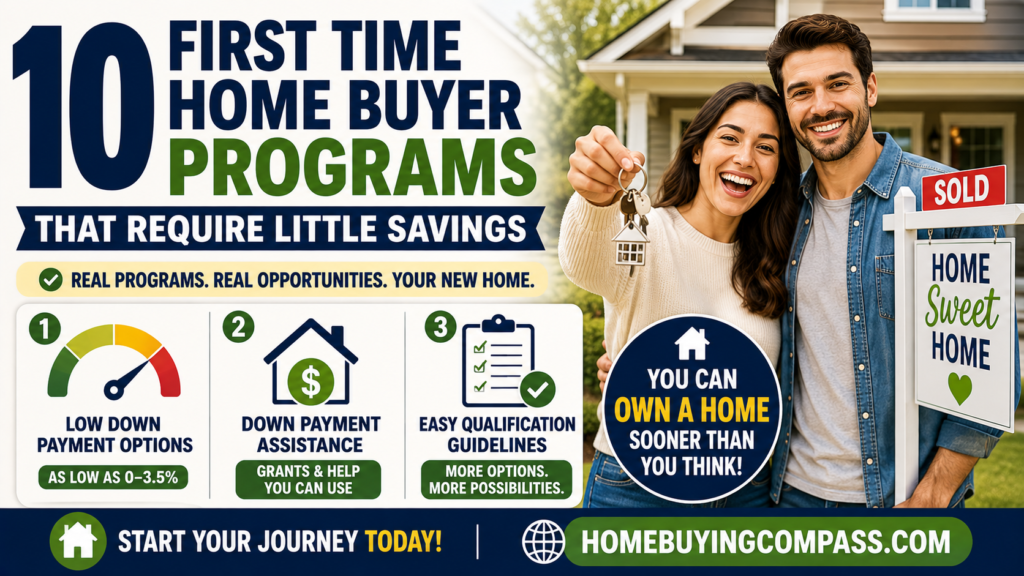
Quick Answer: Yes, you can buy a home with little savings. Programs like FHA loans (3.5% down), USDA loans (0% down), VA loans (0% down), and Conventional 97 loans (3% down) — combined with down payment assistance grants — let many first time buyers purchase a home with $0 to $10,000 out of pocket, depending on the program and location.
That’s the short version. Now let’s get into exactly how, because the details matter more than the headline.
Why Saving 20% Down Is a Myth That Keeps People Renting
Here’s what most first time home buyers don’t realize: the “20% down payment” rule isn’t a requirement. It’s a leftover myth that scares people out of even trying.
In reality, the average first time buyer puts down far less. According to the National Association of Realtors, the typical first time buyer makes a down payment of just 8%. Many programs allow far less than that.
This matters because waiting to save 20% on a $350,000 home means saving $70,000 first. For most people, that could take a decade or more. Meanwhile, home prices keep climbing, and rent keeps eating the money that could’ve gone toward a mortgage.
10 First Time Home Buyer Programs With Low Savings Requirements
Each of these programs solves the same core problem — not having a huge pile of cash sitting in the bank — but they work in different ways depending on your situation.
1. FHA Loans (3.5% Down)
FHA loans are backed by the Federal Housing Administration and are one of the most popular options for buyers with limited savings or lower credit scores. You can qualify with a credit score as low as 580, and if your score is between 500 and 579, you may still qualify with 10% down.
This program exists because it removes two of the biggest barriers at once: low savings and imperfect credit. That combination is exactly what traps so many renters in place.
2. VA Loans (0% Down)
If you’re a veteran, active-duty service member, or eligible surviving spouse, a VA loan lets you buy with zero dollars down. There’s also no private mortgage insurance required, which can save hundreds per month.
This program matters because it directly rewards service with one of the lowest-barrier paths to homeownership that exists.
3. USDA Loans (0% Down)
USDA loans are designed for buyers purchasing in eligible rural or suburban areas, and many areas qualify that don’t feel “rural” at all. Zero down payment is allowed, and income limits apply based on your area.
This is huge for buyers who assumed no-down-payment loans only existed for veterans. It opens the door to a much wider group of people.
4. Conventional 97 Loan (3% Down)
This conventional loan option allows just 3% down for qualified first time buyers. Unlike FHA loans, mortgage insurance can eventually be removed once you build enough equity.
That detail matters long-term because it can lower your monthly payment years down the road, once you’re no longer a brand-new homeowner.
5. Fannie Mae HomeReady Program
HomeReady is built for moderate-income buyers and allows 3% down with flexible credit guidelines. It also allows income from a non-borrowing household member to help you qualify.
This helps because it recognizes something lenders often ignore: many households share income responsibilities, even if only one name goes on the loan.
6. Freddie Mac Home Possible Program
Similar to HomeReady, Home Possible offers 3% down payment options with flexible funding sources, including gifts, grants, and even sweat equity in some cases.
This program is worth knowing because “sweat equity” — literally doing approved repair work yourself — can count toward your contribution in specific situations.
7. State and Local Down Payment Assistance Programs
Nearly every state offers some form of down payment assistance (DPA), often as a grant or a low-interest second loan. Some programs even forgive the loan entirely after you live in the home for a set number of years.
This is where many buyers make a costly mistake — they never even check if their state offers this. As a result, they leave free or low-cost money on the table without realizing it exists.
8. Good Neighbor Next Door Program (HUD)
Teachers, firefighters, EMTs, and law enforcement officers can purchase HUD homes in revitalization areas for 50% off the list price, with as little as $100 down in some cases.
This program exists to reward community-critical workers, and the savings can be dramatic if you qualify and a home is available near you.
9. Doctor and Professional Loan Programs
Many lenders offer specialized loans for nurses, doctors, teachers, and other professionals, sometimes allowing 0-5% down with no private mortgage insurance required.
This matters because it’s built around future earning potential, not just current savings — a completely different way of measuring “readiness” to buy.
10. Employer-Assisted Housing Programs
Some employers, especially hospitals, universities, and city governments, offer down payment assistance or forgivable loans as part of employee benefits.
This one gets overlooked constantly. So it’s worth asking your HR department directly, because many employees never even know the benefit exists.
Comparing the Top Low-Down-Payment Programs
| Program | Minimum Down Payment | Best For | Credit Score Needed |
| FHA Loan | 3.5% | Lower credit scores | 580+ |
| VA Loan | 0% | Veterans & military families | Varies by lender |
| USDA Loan | 0% | Rural/suburban buyers | 640+ (typical) |
| Conventional 97 | 3% | Good credit, long-term savings | 620+ |
| HomeReady / Home Possible | 3% | Moderate-income buyers | 620+ |
A Real Example: How Maria Bought Her First Home With $4,200 Saved
Maria, a 29-year-old dental hygienist in Ohio, assumed she needed $40,000 saved before she could even start looking. Instead, she used an FHA loan at 3.5% down, combined with a state down payment assistance grant that covered most of her closing costs.
In total, Maria brought $4,200 to closing on a $185,000 home. That’s the power of stacking programs instead of assuming only one option exists.
Your Step-by-Step Action Plan
Here’s exactly how to move from “just looking” to “pre-approved,” in order.
- Check your credit score first. This determines which programs you’ll qualify for, so it should always be step one.
- Get pre-approved with 2-3 lenders. Rates and program availability vary, so comparing matters more than people expect.
- Search your state’s housing finance agency website. This is where most down payment assistance programs are listed.
- Ask about stacking assistance programs. Many buyers don’t realize you can often combine a low-down-payment loan with a DPA grant.
- Get pre-qualified for a specific loan type, based on which program fits your credit, income, and location.
- Start house hunting within your approved range, not your dream range, to avoid disappointment later.
- Work with an agent experienced in first time buyer programs, since not every agent understands these options well.
Common Mistakes First Time Buyers Make
- Assuming they need 20% down. This single myth stops more people than any actual financial barrier.
- Not checking down payment assistance until after house hunting. Doing this backward often means missing eligibility windows.
- Applying with only one lender. Different lenders offer different programs, so this limits options unnecessarily.
- Ignoring closing costs. Buyers often save for the down payment but forget closing costs, which typically run 2-5% of the loan amount, according to the Consumer Financial Protection Bureau.
- Waiting for “the perfect time.” Rates and prices shift constantly, so waiting indefinitely often costs more than acting with a solid plan.
You’re Closer Than You Think
The truth is, buying a house feels overwhelming for almost everyone at first. But the barrier most people imagine — needing tens of thousands of dollars saved — usually isn’t real.
Programs like FHA, VA, USDA, and state-level down payment assistance exist because housing agencies know saving a huge lump sum isn’t realistic for most working people. That’s exactly why these programs were created in the first place.
So instead of asking “how much more do I need to save,” start asking “which program fits my situation.” That single shift in mindset is often the difference between renting for another five years and holding your own keys next spring.
Your next step is simple: check your credit score today, then look up your state’s housing finance agency this week. That’s it. That’s how this journey actually starts.
Frequently Asked Questions
How much money do I actually need to buy my first home? Many buyers can purchase a home with as little as 0-3.5% down, depending on the program. For a $250,000 home, that could mean anywhere from $0 to $8,750 in down payment, plus closing costs.
What credit score do I need for a low down payment loan? FHA loans allow scores as low as 580 for 3.5% down, while conventional low-down-payment programs typically require at least 620.
Can I combine down payment assistance with an FHA or conventional loan? Yes, in most cases you can stack a low-down-payment loan with a state or local down payment assistance grant, which is one of the most underused strategies among first time buyers.
Do all these programs require mortgage insurance? Most low-down-payment options, except VA loans, require some form of mortgage insurance until you build sufficient equity, typically around 20%.
Are these programs only for people with low income? No. Programs like FHA and Conventional 97 aren’t income-restricted, though some programs like HomeReady and USDA loans do have income limits based on your area.
How long does it take to get pre-approved? Pre-approval typically takes anywhere from a few hours to a few days, depending on the lender and how quickly you provide documentation.
Where can I find down payment assistance programs in my state? Your state’s housing finance agency website is the most reliable source, and HUD’s official website also maintains a directory of local resources.
Is it better to wait and save more before buying? Not necessarily. Home prices and interest rates often rise over time, so waiting can sometimes cost more than buying sooner with a lower-down-payment program.