Buying a home alone feels different. There’s no second income to lean on, no partner to split the down payment with, and no one else to blame if the numbers don’t work out. If you’ve ever stared at your bank account and wondered whether homeownership is even possible on one salary, you’re not imagining the challenge — you’re living it.
Here’s the good news: you don’t need a partner, a inheritance, or a six-figure salary to buy your first home. You need the right program.
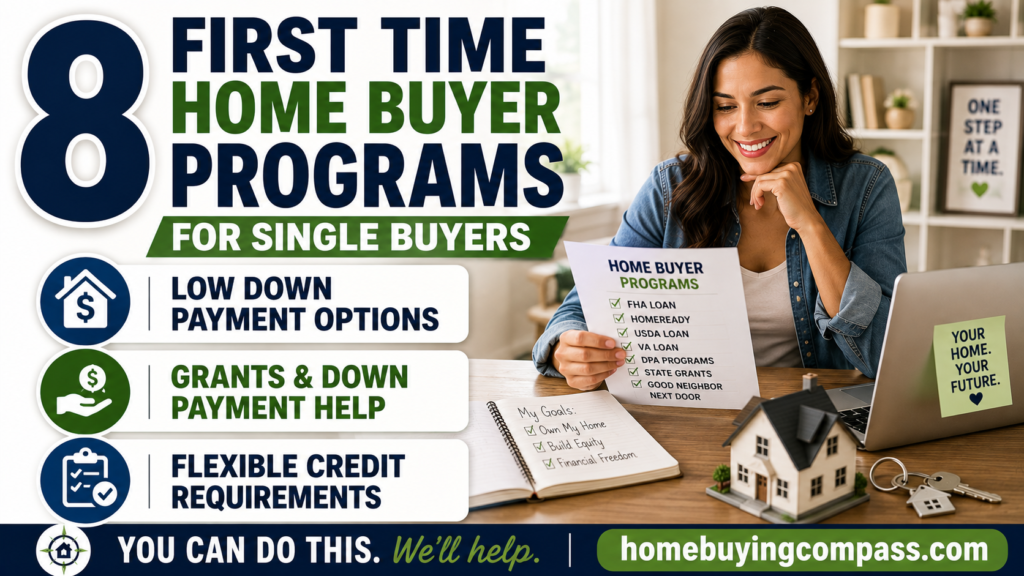
Quick Answer: Single, first time home buyers can qualify for programs like FHA loans (3.5% down), Fannie Mae HomeReady, Freddie Mac Home Possible, USDA loans (0% down in eligible areas), VA loans (for veterans), state housing finance agency grants, Good Neighbor Next Door, and local down payment assistance programs. Most require a credit score of 580–620 or higher, and many combine with grants that cover part or all of your down payment and closing costs.
That’s the short version. Now let’s talk about what actually matters: which one fits your life.
Why Buying Alone Feels Harder (And Why It Isn’t Impossible)
The truth is, buying a house feels overwhelming for almost everyone — married couples included. But when you’re doing it solo, every number lands differently. One income means one debt-to-income ratio, one credit score, and one paycheck standing between you and approval.
This is exactly why so many single buyers stay stuck renting longer than they planned. They assume they need 20% down and perfect credit. They don’t.
In reality, most first time buyer programs were built for exactly this situation: one qualified income, a modest savings account, and a strong desire to stop paying someone else’s mortgage.
The 8 Best First Time Home Buyer Programs for Single Buyers
1. FHA Loans
FHA loans, backed by the Federal Housing Administration, let you buy with as little as 3.5% down if your credit score is 580 or higher. Even with a score as low as 500, you may qualify with 10% down.
This matters because FHA loans focus more on your overall financial picture than a flawless credit history. If you’ve had a rocky financial year, this door is often still open.
2. Fannie Mae HomeReady
HomeReady allows down payments as low as 3% and is designed for buyers with moderate income. It also allows income from a roommate or renter to help you qualify, which is a huge advantage for single buyers.
Why it matters: your solo income might not stretch as far on paper, but this program looks at your full situation, not just your paycheck.
3. Freddie Mac Home Possible
Similar to HomeReady, Home Possible offers 3% down payment options and flexible credit requirements. It’s built specifically for low-to-moderate income buyers, which often includes single earners in expensive markets.
4. USDA Loans
If you’re open to living outside a major city, USDA loans offer 0% down payment financing in eligible rural and suburban areas. That single detail — zero down — can shave years off your savings timeline.
This program matters most for single buyers because saving a down payment alone, on one income, is usually the single biggest barrier to homeownership.
5. VA Loans
If you’re a veteran, active-duty service member, or eligible surviving spouse, VA loans offer 0% down and no private mortgage insurance. According to the Department of Veterans Affairs, this is one of the most powerful benefits available to those who qualify.
6. State Housing Finance Agency (HFA) Programs
Nearly every state runs its own housing finance agency offering below-market interest rates and down payment assistance specifically for first time buyers. These programs change often, so it’s worth checking your state’s HFA directly.
Why this matters: state programs are frequently underused simply because people don’t know they exist.
7. Good Neighbor Next Door
If you work as a teacher, firefighter, EMT, or law enforcement officer, this HUD program offers homes at 50% off the list price in revitalization areas. It’s one of the most overlooked programs for single, public-service buyers.
8. Local Down Payment Assistance (DPA) Programs
Thousands of city and county programs offer grants or forgivable loans that cover part — or sometimes all — of your down payment and closing costs. The Consumer Financial Protection Bureau recommends checking with your local housing authority before assuming you need to save everything yourself.
Program Comparison at a Glance
| Program | Min. Down Payment | Min. Credit Score | Best For |
| FHA Loan | 3.5% | 580 | Buyers with fair credit |
| Fannie Mae HomeReady | 3% | 620 | Moderate income earners |
| Freddie Mac Home Possible | 3% | 660 | Low-to-moderate income |
| USDA Loan | 0% | 640 | Rural/suburban buyers |
| VA Loan | 0% | Varies by lender | Veterans & military |
| State HFA Programs | Varies | Varies | State-specific assistance |
| Good Neighbor Next Door | 3.5% (FHA) | 580 | Teachers, first responders |
| Local DPA Programs | Often $0 out of pocket | Varies | Grant-based assistance |
A Real Example: Meet Jasmine
Jasmine, a 29-year-old nurse in Ohio, assumed she’d need $40,000 saved before she could even think about buying. She had $6,000 and a 640 credit score.
Instead of waiting, Jasmine combined an FHA loan with a local down payment assistance grant through her city’s housing authority. Her out-of-pocket cost at closing? Under $2,500.
Two years later, she’s building equity instead of paying rent increases every January. Her story isn’t rare — it’s simply not talked about enough.
Your Step-by-Step Path to Homeownership
Getting from “renting” to “homeowner” isn’t one giant leap. It’s a series of small, manageable steps.
- Check your credit score and dispute any errors — this alone can improve your rate.
- Calculate your real budget, not just what a lender says you’re approved for.
- Research state and local down payment assistance programs before you assume you need full savings.
- Get pre-approved with at least two lenders to compare rates and fees.
- Talk to a HUD-approved housing counselor — many offer free guidance for first time buyers.
- Choose the loan program that fits your income and location, using the comparison above as a starting point.
- Start house hunting with your pre-approval letter in hand.
- Close on your home — and start building equity instead of paying someone else’s mortgage.
Common Mistakes Single Buyers Make
Even motivated buyers trip over the same few mistakes. Here’s what to watch for.
- Assuming you need 20% down. Most first time buyers put down far less, often 3–5%.
- Skipping down payment assistance research. Many buyers never check because they assume they won’t qualify.
- Applying for new credit before closing. A new credit card or car loan can delay or derail your approval.
- Ignoring debt-to-income ratio. Lenders care about this as much as your credit score, so pay down revolving debt first.
- Waiting for “perfect” savings. Programs exist specifically because most people never hit that number — and don’t need to.
Why Your Credit Score Matters More Than Your Income
Many single buyers assume income is the deciding factor. In reality, your credit score often determines your interest rate, and even a 20-point difference can change your monthly payment by hundreds of dollars over the loan’s life.
According to the Federal Housing Administration, buyers with scores above 580 access significantly better loan terms — which is why checking and improving your score should be step one, not an afterthought.
You’re Closer Than You Think
Buying a home on one income can feel like running a race with a head start missing. But the programs above exist precisely because lenders, states, and the federal government recognize that single buyers are a huge, deserving part of the market.
You don’t need a partner’s income. You don’t need perfect credit. You need the right combination of programs, a little research, and a first step.
Start with your credit score. Start with one phone call to a housing counselor. Start today — because a year from now, you’ll either still be renting, or you’ll be unlocking your own front door.
FAQ Section
Can a single person qualify for a first time home buyer program? Yes. Programs like FHA, HomeReady, and Home Possible are designed for one-income households and don’t require a co-borrower.
What credit score do I need to buy a house alone? Most programs accept scores as low as 580, though some, like Home Possible, prefer 660 or higher for the best rates.
Is it harder to get approved for a mortgage as a single buyer? Not necessarily. Lenders evaluate your individual debt-to-income ratio and credit profile, not your relationship status.
How much down payment do I actually need? Many programs allow 3% to 3.5% down, and some, like USDA and VA loans, require 0% down for eligible buyers.
Can I combine down payment assistance with an FHA loan? Yes. This is one of the most common — and effective — strategies single buyers use to reduce out-of-pocket costs at closing.
Do first time home buyer programs only apply to first-time buyers? Most do, but “first time buyer” often means you haven’t owned a home in the last three years, not that you’ve never owned one at all.
What if my income is too low to qualify alone? Programs like HomeReady allow boarder or rental income to count toward qualification, which can help single buyers meet income requirements.
Where do I find local down payment assistance programs? Check your city or county housing authority website, or ask a HUD-approved housing counselor for a full list in your area.