Somewhere along the way, you probably heard you need 20% down to buy a house. So you did the math, saw a number like $60,000 sitting between you and your front door, and quietly gave up on the dream for another year. Or five.
Here’s what most first-time home buyers don’t realize: that 20% number is a myth for most buyers. The real minimum is often far lower — sometimes as low as zero.
Let’s clear up the confusion, once and for all.
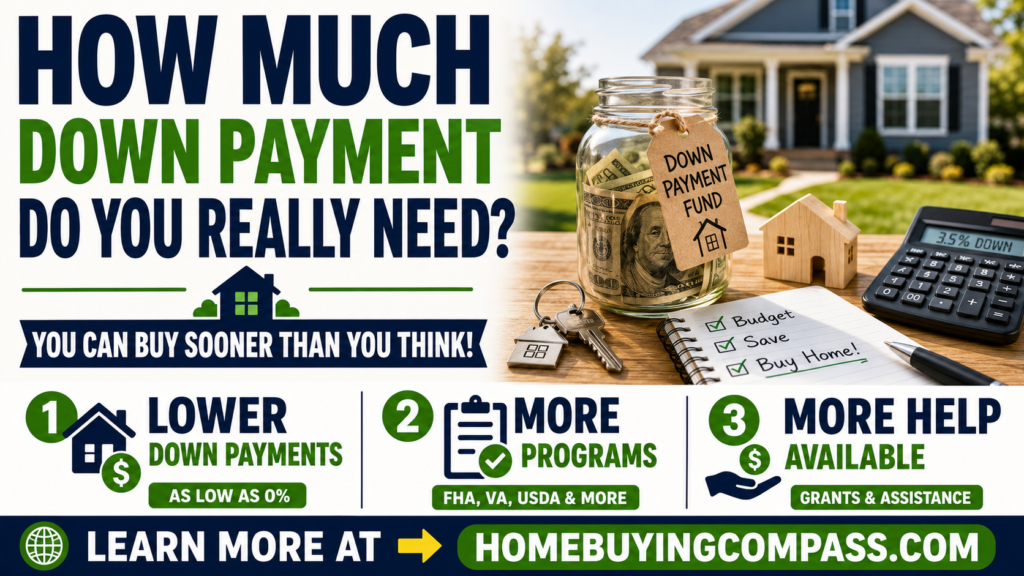
Quick Answer: Most first-time home buyers don’t need 20% down. Conventional loans allow as little as 3% down, FHA loans require 3.5% down with a 580+ credit score, and VA and USDA loans can require $0 down for eligible buyers. On a $350,000 home, that means your down payment could range from $0 to $12,250 depending on the loan you choose — not $70,000.
Why the “20% Down Payment” Myth Refuses to Die
The 20% rule isn’t a law. It’s an old guideline that mortgage lenders use to skip Private Mortgage Insurance (PMI). That’s it. That’s the whole reason it exists.
So why does everyone still believe it? Because it’s the number your parents mentioned, the number finance blogs repeat, and the number that makes homeownership feel impossible. In fact, according to the National Association of Realtors, the median down payment for first-time buyers has hovered around 8% in recent years — nowhere near 20%.
This is exactly why so many people stay stuck renting longer than they planned. They’re saving for a number they never actually needed.
How Much Down Payment You Actually Need, by Loan Type
Your real minimum down payment depends entirely on which loan program you qualify for. This is where things get exciting, because you have more options than you think.
Conventional Loans: As Low As 3% Down
Conventional loans aren’t backed by the government, but many still allow a 3% down payment for first-time buyers through programs like Fannie Mae’s HomeReady or Freddie Mac’s Home Possible. However, you’ll typically need a credit score of at least 620, and you’ll pay PMI until you reach 20% equity.
FHA Loans: 3.5% Down (or 10% With Lower Credit)
FHA loans, backed by the Federal Housing Administration, are one of the most forgiving options for buyers with limited savings or imperfect credit. If your credit score is 580 or higher, you only need 3.5% down. Score between 500 and 579? You’ll need 10% down instead.
On a $300,000 home, that 3.5% minimum comes out to just $10,500 — a number that’s actually reachable within a year or two of focused saving, instead of a decade.
VA Loans: $0 Down for Eligible Veterans
If you’re an eligible veteran, active-duty service member, or surviving spouse, a VA loan can let you buy with zero down payment. No PMI is required either, which is a huge long-term savings. You can learn more about eligibility directly through the VA’s home loan program.
USDA Loans: $0 Down in Eligible Rural Areas
USDA loans also allow $0 down for buyers purchasing in eligible rural or suburban areas, as long as household income falls within local limits. Many buyers assume “rural” means the middle of nowhere — but plenty of USDA-eligible areas are just outside major cities.
Down Payment Assistance Programs: Sometimes $0 Out of Pocket
On top of all of this, thousands of state and local down payment assistance (DPA) programs exist specifically to help first-time buyers cover their down payment through grants or low-interest second loans. Many buyers stack DPA funds with an FHA loan and walk into closing having paid almost nothing upfront.
Down Payment Comparison Table
| Loan Type | Minimum Down Payment | Credit Score Needed | PMI Required? | Best For |
| Conventional | 3% | 620+ | Yes, until 20% equity | Buyers with decent credit and steady income |
| FHA | 3.5% (10% if 500–579) | 580+ | Yes, for the life of most loans | Buyers with limited savings or lower credit |
| VA | 0% | No official minimum, lenders often want 580–620 | No | Veterans, active duty, and eligible spouses |
| USDA | 0% | Typically 640+ | No, but has a guarantee fee | Buyers in eligible rural/suburban areas |
A Real Example: Meet Danielle
Danielle, a 29-year-old nurse in Ohio, spent two years believing she needed $40,000 saved before she could even talk to a lender. She was renting a one-bedroom apartment for $1,400 a month and felt like homeownership was always going to be someone else’s story.
Then a coworker mentioned FHA loans. Danielle had a 610 credit score and $9,000 saved. Instead of waiting another three years, she qualified for an FHA loan on a $260,000 home with just 3.5% down — around $9,100 — plus a small local grant that covered part of her closing costs.
She moved in five months after that conversation. Not five years.
Step-by-Step: How to Figure Out Your Down Payment
Instead of guessing, walk through these steps in order. Each one builds directly on the last.
- Check your credit score first. This determines which loan programs you even qualify for, so it’s the true starting point — not your savings account.
- Get pre-qualified with two or three lenders. Because requirements vary, one lender might offer better terms than another for the exact same profile.
- Ask specifically about FHA, conventional, VA, and USDA options. Not every loan officer volunteers all four upfront, so you have to ask directly.
- Search for down payment assistance in your state. Programs are often run locally, so a quick search for “[your state] down payment assistance” can uncover thousands of dollars you didn’t know existed.
- Calculate your real target number. Multiply the home price you’re considering by your loan’s minimum percentage — not by 20%.
- Factor in closing costs separately. These typically run 2% to 5% of the purchase price and are a different expense than your down payment, according to the Consumer Financial Protection Bureau.
- Start an automatic monthly savings transfer. Even $200 a month adds up faster than you’d expect once your real target is smaller and clearer.
Why a Bigger Down Payment Still Matters (Even If You Don’t Need One)
Putting down less money doesn’t mean you should. A larger down payment lowers your monthly payment, reduces your total interest paid, and in some cases removes PMI entirely. So if you can comfortably save more without draining your emergency fund, it’s often worth it.
However, waiting years to hit 20% while rent keeps rising can cost you more than PMI ever would. There’s no universal right answer here — only the right answer for your situation.
Common Mistakes First-Time Buyers Make With Down Payments
Even motivated buyers trip over the same few issues. Here’s what to watch for.
- Assuming they don’t qualify without ever asking a lender. Many buyers rule themselves out based on assumptions, not actual pre-qualification numbers.
- Draining their entire savings for the down payment. This leaves nothing for moving costs, repairs, or emergencies right after closing.
- Ignoring down payment assistance because it “sounds too good to be true.” These programs are real, funded, and specifically designed for buyers like you.
- Waiting for a “perfect” credit score. A 580 or 620 is often enough to move forward, especially with FHA financing.
- Forgetting that closing costs are separate from the down payment. This surprises more buyers than almost anything else in the process.
Frequently Asked Questions
Do I really need 20% down to buy a house? No. Most first-time buyers use loans that allow between 0% and 3.5% down. The 20% figure only matters if you want to avoid PMI on a conventional loan.
What credit score do I need for the lowest down payment option? For FHA loans, a 580 credit score qualifies you for the 3.5% minimum. Conventional loans with 3% down typically require a 620 or higher.
Can I use gift money for my down payment? Yes, on most loan types, including FHA, you can use documented gift funds from family members, employers, or approved charities to cover part or all of your down payment.
Is a smaller down payment a bad financial decision? Not necessarily. It depends on your monthly budget, how long you plan to stay in the home, and whether PMI costs less than continuing to rent while you save.
How much should I save for closing costs on top of my down payment? Plan for roughly 2% to 5% of the home’s purchase price, separate from your down payment funds.
Do down payment assistance programs need to be repaid? Some are outright grants, while others are low-interest or forgivable second loans. Requirements vary by state and program, so ask your lender or local housing agency directly.
You’re Closer to Homeownership Than You Think
If you’ve been putting your dream on hold because of a number that felt impossible, take a breath. That number was probably never true for you in the first place.
Your real down payment might be thousands of dollars smaller than you imagined — or, in some cases, nothing at all. The only way to know for sure is to check your credit score and talk to a lender this week, not “someday.”
Danielle didn’t wait for the perfect moment. She just asked the right question. You can too.