Introduction
You’ve been thinking about buying a house for a while now. Maybe you’ve even done some late-night Zillow scrolling, imagining what it would feel like to walk through your own front door.
But then the doubts creep in.
What about the down payment? My credit score isn’t perfect. Do I even make enough money?
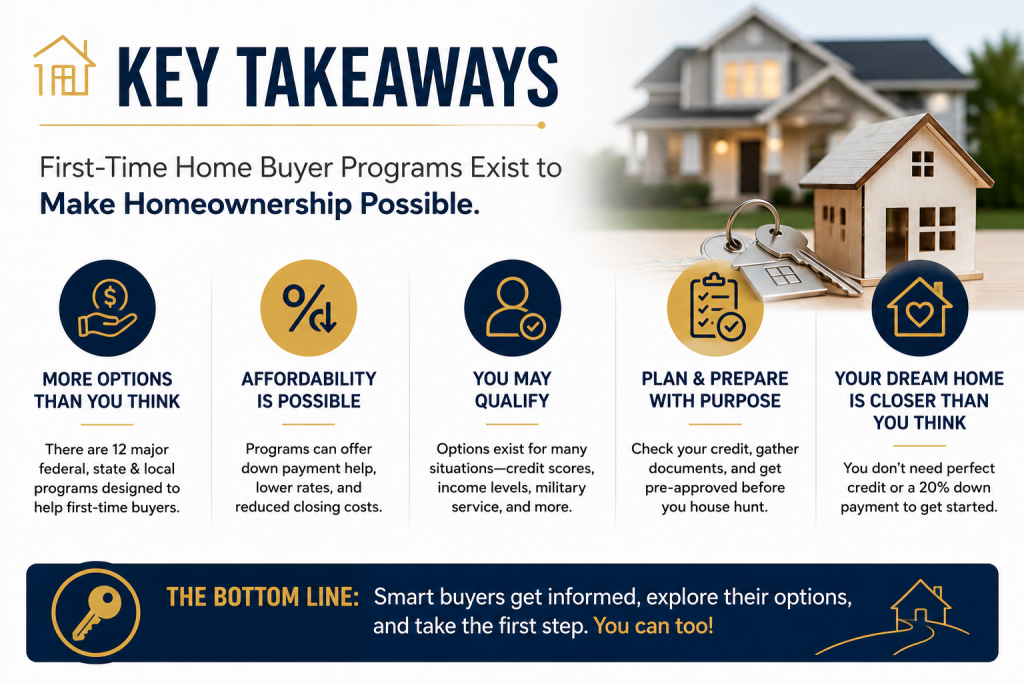
Here’s what most first time home buyers don’t realize: you probably have more options than you think. There are federal, state, and local programs specifically designed to help people just like you — people who are ready to stop renting and start building something real.
And the best part? Many of these programs offer down payment assistance, lower mortgage rates, and reduced closing costs that can make buying a house more affordable than you ever imagined.
Let’s break them all down.
Why First Time Home Buyer Programs Exist
The home buying process wasn’t always this complicated.
Decades ago, saving up and walking into a bank worked fine. Today, home prices have climbed dramatically while wages haven’t always kept pace. That gap — between what homes cost and what most Americans can save — is exactly why these programs were created.
They’re not handouts. They’re tools. Smart buyers use them.
The 12 Best First Time Home Buyer Programs
1. FHA Loan (Federal Housing Administration)
This is the most popular loan program for first time buyers — and for good reason.
An FHA loan allows you to put down as little as 3.5% of the purchase price if your credit score is 580 or higher. Even if your score is between 500 and 579, you may still qualify with a 10% down payment.
Why buyers love it:
- Low minimum credit score requirement
- More flexible debt-to-income ratio guidelines
- Available through most major lenders
This is where many buyers make a smart move by exploring FHA first, especially if their credit history has a few bumps.
2. USDA Loan (U.S. Department of Agriculture)
Think USDA loans are only for farmers? Think again.
USDA loans are available to buyers purchasing homes in eligible rural and suburban areas — and they come with zero down payment required. That’s right. None.
If you’re open to living outside major city centers, this could be one of the most powerful mortgage programs available to you. Income limits apply, but they’re often more generous than people expect.
3. VA Loan (Department of Veterans Affairs)
If you’re a veteran, active-duty service member, or eligible surviving spouse, the VA loan is one of the best financial tools in existence.
Key benefits:
- No down payment required
- No private mortgage insurance (PMI)
- Competitive mortgage rates
- Easier qualification standards
If you’ve served, you’ve earned this benefit. Use it.
4. Fannie Mae HomeReady Loan
Designed specifically for low-to-moderate income buyers, the HomeReady loan allows a down payment as low as 3%.
What makes this program special is that it counts income from household members who aren’t on the loan — like a parent or roommate — toward your qualification. This is a game-changer for multi-generational households or buyers in high-cost areas.
5. Freddie Mac Home Possible Loan
Similar to HomeReady, the Home Possible loan also offers a 3% down payment option with flexible income guidelines.
It’s designed to help buyers in underserved communities and those with non-traditional income sources. Freelancers, gig workers, and self-employed buyers — this one might be for you.
6. HUD Good Neighbor Next Door Program
Teachers, law enforcement officers, firefighters, and emergency medical technicians can buy a home at a 50% discount off the list price in designated areas through this HUD program.
Yes, 50% off.
The catch: you must live in the home for at least three years. But for qualifying professionals, this is one of the most underutilized deals in the entire home buying process.
7. State-Based First Time Home Buyer Programs
Every state in the U.S. runs its own housing finance agency — and most of them offer first time buyer programs with real benefits.
These programs often include:
- Down payment assistance (grants or low-interest loans)
- Below-market mortgage rates
- Closing cost help
Examples include the California Dream For All Shared Appreciation Loan, the Texas State Affordable Housing Corporation (TSAHC) program, and Florida’s Hometown Heroes program. Search your state’s housing finance agency to see what’s available where you live.
8. Down Payment Assistance (DPA) Grants
Here’s something that surprises almost every first time buyer: you may be able to get grant money toward your down payment that you never have to pay back.
DPA grants are offered by state agencies, nonprofits, and even some employers. Amounts vary widely — from $2,500 to $25,000 or more in some areas.
The key is knowing where to look. Start with your state’s housing agency website and ask your lender directly. Many first time buyers leave thousands of dollars on the table simply because they didn’t ask.
9. First-Generation Down Payment Assistance (Proposed Federal Program)
This program has been on the federal policy agenda to specifically help buyers whose parents were renters — people who didn’t inherit homeownership knowledge or wealth.
If passed at the federal level, this could provide up to $25,000 in down payment assistance to eligible first-generation buyers. Keep an eye on this one. It could be transformative.
10. Native American Direct Loan (NADL)
Administered by the VA, the NADL program helps eligible Native American veterans purchase, construct, or improve homes on Federal Trust Land.
It offers no down payment, no PMI, and a fixed 30-year mortgage rate. If you qualify, this program deserves serious consideration.
11. Energy Efficient Mortgage (EEM)
Want to buy a fixer-upper and make it energy-efficient? Or purchase a home that’s already green?
The EEM program lets you roll the cost of energy improvements into your mortgage — without increasing your down payment requirements.
This is a smart long-term move. Lower utility bills mean your monthly housing costs go down over time, which makes your mortgage more manageable than it looks on paper.
12. Individual Development Accounts (IDAs)
IDAs are matched savings accounts, often offered through nonprofits and local housing programs, designed to help low-to-moderate income buyers save for a down payment.
Here’s how it works: for every dollar you save, a matched contribution (sometimes 2:1 or even 3:1) is added by the sponsoring organization.
If you’re earlier in your home buying journey and still building up savings, this is worth exploring. Matched savings can double or triple your down payment fund faster than you’d expect.
How to Know Which Program Is Right for You
This is where it gets personal.
The best program for you depends on:
- Your credit score (and where it stands today)
- Your income and employment type
- Where you want to buy (city vs. suburban vs. rural)
- How much you’ve saved for a down payment
- Whether you’ve served in the military
- What state you live in
The smartest first step? Talk to a HUD-approved housing counselor. It’s free, and they can walk you through every program you qualify for without trying to sell you anything.
Quick Tips Before You Apply for Any Program
Getting mortgage approval is easier when you prepare ahead of time.
- Check your credit score — and dispute any errors you find
- Avoid new debt before and during the application process
- Save documentation — pay stubs, tax returns, bank statements
- Get pre-approved before house hunting so you know your real budget
- Ask your lender about all programs — many buyers never hear about options they qualify for
The Truth About Buying Your First Home
The truth is, buying a house feels overwhelming for almost everyone at first.
But the buyers who succeed aren’t the ones who waited until everything was perfect. They’re the ones who got informed, took the first step, and let the programs designed for them do the heavy lifting.
You don’t need a 20% down payment. You don’t need a perfect credit score. You need a plan, the right information, and the willingness to ask for help.
That home you’ve been imagining? It’s closer than you think.
FAQ: First Time Home Buyer Programs
Q: What qualifies you as a first time home buyer? Most programs define a first time buyer as someone who hasn’t owned a primary residence in the past three years. Even if you’ve owned a home before, you may still qualify.
Q: What credit score do I need to buy a house for the first time? It depends on the loan type. FHA loans allow scores as low as 580 (with 3.5% down) or 500 (with 10% down). Conventional loans typically require a 620 or higher for the best terms.
Q: Can I get a mortgage with no down payment as a first time buyer? Yes. USDA loans and VA loans both offer zero down payment options for qualifying buyers.
Q: How much down payment assistance can I get? It varies widely by state and program — anywhere from $2,500 to $25,000 or more. Some grants don’t need to be repaid at all.
Q: How long does the home buying process take for first time buyers? From mortgage pre-approval to closing, the process typically takes 30–60 days once you find a home. Getting pre-approved before you start shopping can speed things up significantly.
Q: Should I use a first time home buyer program or a regular mortgage? Most first time buyer programs offer the same loan products (FHA, conventional, VA) but with added benefits like lower rates or down payment help. There’s rarely a reason not to use them if you qualify.