You’ve been staring at your credit score app for weeks, watching that number creep up, wondering if it’s finally “good enough” to buy a house. If you just hit 580, here’s the good news: it is. FHA loans were built for exactly this moment.
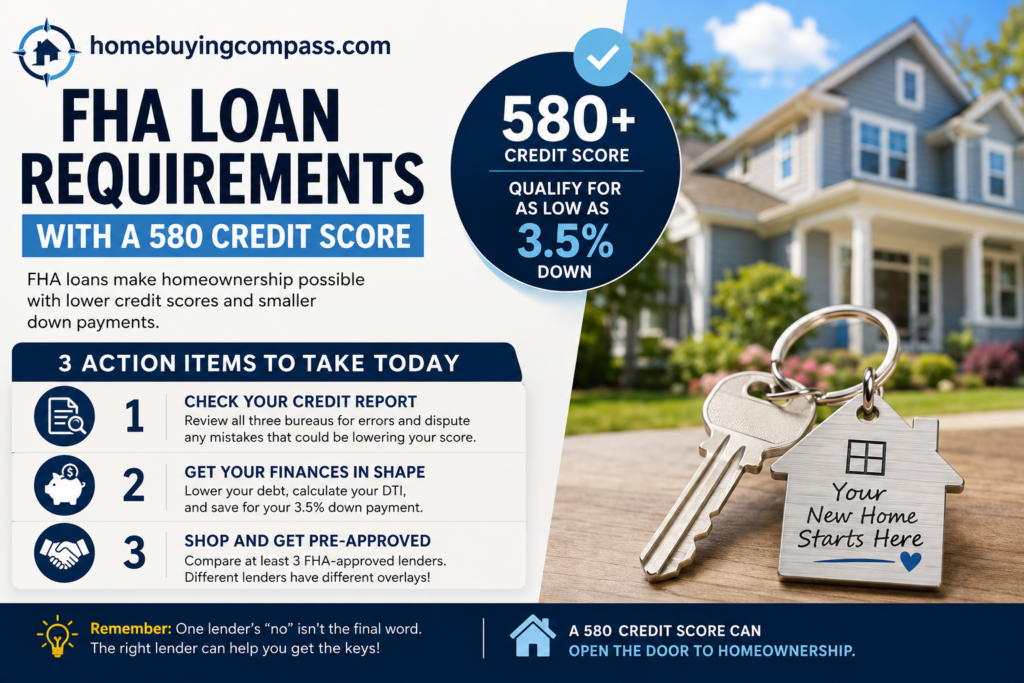
Quick Answer: With a 580 credit score, you qualify for an FHA loan with just 3.5% down. That means on a $300,000 home, you’d need around $10,500 for your down payment instead of the $60,000 many people assume they need. Fall between 500 and 579, and you can still qualify — you’ll just need 10% down instead.
That’s it. That’s the number everyone’s been Googling at 1 a.m.
But there’s a lot more to know before you walk into a lender’s office, and this is where most first-time buyers either save thousands of dollars or accidentally cost themselves thousands more.
What Credit Score Do You Need for an FHA Loan?
The FHA (Federal Housing Administration) uses a two-tier system, and it’s simpler than it sounds:
- 580 or higher: You qualify for the minimum down payment of 3.5%
- 500–579: You can still qualify for an FHA loan, but you’ll need 10% down
- Below 500: You’re generally not eligible for FHA financing
Here’s what most first-time home buyers don’t realize: FHA doesn’t actually issue the loan. The FHA insures it, and an approved private lender — a bank, credit union, or mortgage company — is the one handing you the money. That distinction matters, because it explains the next section.
Why Your Lender Might Say No, Even If FHA Says Yes
This is where many buyers make a costly mistake. They assume every lender follows FHA’s exact minimums. They don’t.
Lenders are allowed to set their own stricter standards on top of FHA’s rules. This is called a “lender overlay.” <cite index=”8-1″>Some banks won’t touch an FHA file below a 620 credit score, even though FHA itself permits 580.</cite>
So if one lender turns you down at 580, that’s not the final word. It just means you talked to the wrong lender. Credit unions and online FHA-focused lenders are often more willing to work with borrowers right at the 580 line, so shopping around isn’t optional — it’s essential.
FHA Loan Requirements at a Glance
Your credit score is the headline, but it’s not the only requirement. Here’s the full picture for 2026.
| Requirement | Minimum Standard |
|---|---|
| Credit score (3.5% down) | 580 or higher |
| Credit score (10% down) | 500–579 |
| Down payment | 3.5% (580+) or 10% (500–579) |
| Debt-to-income ratio (DTI) | Typically up to 43%, though exceptions can reach higher with strong compensating factors |
| Mortgage insurance | Upfront premium plus an annual premium, both required |
| Property use | Must be your primary residence |
| Loan limits (most areas) | Around $524,225–$541,287 for a single-family home |
| Loan limits (high-cost areas) | Up to roughly $1.2 million |
Because down payment assistance programs, gift funds, and loan limits vary by state, it’s worth checking your local numbers before you get attached to a specific home.
FHA vs. Conventional Loans: Which One Actually Fits You?
If you’ve been comparing loan types until your eyes glaze over, here’s the plain-language breakdown.
| Factor | FHA Loan | Conventional Loan |
|---|---|---|
| Minimum credit score | 580 (500 with 10% down) | Usually 620+ |
| Minimum down payment | 3.5% | 3%–5%, but often stricter to qualify |
| Mortgage insurance | Required for the life of the loan in most cases | Can be removed once you reach 20% equity |
| Best for | Lower credit scores, smaller savings | Stronger credit, larger down payment |
| DTI flexibility | More forgiving | Generally stricter |
Neither one is “better” across the board. FHA exists specifically to make homeownership possible for people who don’t have a 720 credit score and $60,000 sitting in a savings account. If that’s you, this program was built with you in mind.
The Truth About FHA Mortgage Insurance
Here’s what a lot of blog posts leave out: FHA loans require mortgage insurance, and it’s not optional.
You’ll pay an upfront premium of about 1.75% of your loan amount, plus an ongoing annual premium. Unlike conventional loans, this insurance typically stays on your loan for its full life unless you put down 10% or more, in which case it can potentially be removed after 11 years.
It’s an extra cost, and it’s fair to feel a little frustrated by that. But think of it this way: that insurance is exactly why lenders are willing to approve someone with a 580 score in the first place. It’s the trade-off that makes the low credit threshold possible.
A Real Scenario: Meet Jasmine
Jasmine is a 29-year-old dental hygienist in Ohio. She’d been renting for six years and assumed buying was years away because her credit score sat at 587 after a rough stretch of medical bills in her mid-twenties.
She almost didn’t apply. Then a coworker mentioned FHA loans, and Jasmine ran the numbers on a $220,000 starter home.
At 3.5% down, she needed $7,700 — money she already had saved from tax refunds and a side gig doing weekend hair styling. Her first lender quoted her a rate but mentioned they preferred a 620 minimum. Instead of giving up, she called two more lenders. The third one approved her at 587, no problem.
She closed on her home four months after that first conversation. Her score wasn’t perfect. Her patience with lender-shopping is what got her the keys.
Step-by-Step: How to Get an FHA Loan With a 580 Credit Score
- Pull your credit report from all three bureaus and check for errors. Disputing even one mistake can bump your score a few points.
- Calculate your debt-to-income ratio by adding up your monthly debt payments and dividing by your gross monthly income.
- Save your 3.5% down payment, or research local down payment assistance programs that may cover it for you.
- Get pre-approved with at least three FHA-approved lenders, since overlays vary so much from one lender to the next.
- Compare the offers, paying attention to the interest rate, closing costs, and any lender-specific requirements.
- Gather your documentation — pay stubs, tax returns, bank statements, and proof of employment history.
- Submit your full application with your chosen lender and stay responsive to document requests.
- Get a home appraisal, which for FHA loans also checks that the property meets HUD’s minimum safety standards.
- Close on your home, reviewing your closing disclosure carefully before signing.
Related reading: [How to Save for a Down Payment as a First-Time Buyer]
Common Mistakes That Cost Buyers Their Approval
Even good candidates trip themselves up. Watch for these:
- Opening a new credit card before closing. New credit inquiries and balances can shift your DTI or credit score right when it matters most.
- Financing a car mid-process. This is one of the most common approval-killers, and it happens more than lenders would like to admit.
- Assuming one lender’s “no” is final. As Jasmine’s story shows, the second or third lender is often the one who says yes.
- Forgetting to budget for mortgage insurance. It affects your monthly payment, so factor it in before you fall in love with a listing.
- Draining savings for the down payment. Lenders want to see reserves left over after closing, not an empty account.
What If You’re Not at 580 Yet?
If your score is sitting in the 560s or 570s, you’re closer than you think. Paying down revolving credit card balances and correcting report errors can realistically move your score into the 580+ tier within three to six months.
That difference — 10% down versus 3.5% down — is often tens of thousands of dollars. It’s worth the wait if you’re close.
Frequently Asked Questions
Can I get an FHA loan with a 580 credit score and no down payment? No. FHA requires at least 3.5% down at a 580 score, though down payment assistance programs or gift funds can cover that amount for you.
Does everyone with a 580 score get approved for an FHA loan? Not automatically. Lenders also look at your debt-to-income ratio, employment history, and income stability, and some lenders set stricter minimums than FHA requires.
Is an FHA loan a bad idea because of mortgage insurance? Not necessarily. It’s a trade-off for a lower credit and down payment requirement, and for many first-time buyers, it’s the only realistic path into homeownership right now.
Can I use gift money for my FHA down payment? Yes. Family members, employers, charities, and approved government programs can contribute, as long as the gift is properly documented.
How long does FHA loan approval typically take? Most FHA loans close within three to six weeks, depending on how quickly you provide documentation and how busy your lender is.
What credit score do I need if I only have 500? A 500 score can still qualify for FHA financing, but you’ll need a 10% down payment instead of 3.5%.
You’re Closer Than You Think
Buying a house feels overwhelming for almost everyone, and if your credit score has ever made you feel like you’re behind, that feeling is common — but it isn’t the full story. A 580 score isn’t a weakness you have to apologize for. It’s a number FHA specifically designed a program around.
Start by checking your credit report for errors this week. Then call a few FHA-approved lenders and let them compete for your business. The buyer who gets denied is usually the one who stopped after the first no.
Disclaimer: This article is provided for general educational and informational purposes only and should not be considered legal, financial, tax, lending, investment, or real estate advice. Every home buying situation is unique. Before making any financial or legal decisions, consult with a licensed real estate agent, mortgage professional, real estate attorney, tax advisor, financial advisor, or other qualified professional who can provide guidance based on your individual circumstances.