You Don’t Have a “Normal” Paycheck. That Doesn’t Mean You Don’t Deserve a Home.
If you’ve ever stared at a mortgage application and felt your stomach drop at the words “proof of consistent income,” you’re not alone.
Perhaps you’re a freelancer. Or maybe you work on commission, or your hours shift every week, and your business has good months and quiet months right after.
Somewhere along the way, you started believing a scary story: lenders only want people with a perfect nine-to-five paycheck.
Here’s the truth. That story is outdated.
Because millions of people with variable income buy homes every single year. So the real task isn’t changing who you are — it’s understanding how the system actually works, not the version everyone assumes is true.
Why This Feels So Overwhelming (And Why It’s Not Your Fault)
Here’s what most first time home buyers don’t realize: mortgage approval was never really about how much you make in one single month.
Instead, it’s about patterns.
Lenders aren’t trying to catch you off guard. In fact, they’re only trying to answer one simple question: can this person reliably make payments over time?
So why does this feel so confusing? Mostly because nobody explains it clearly. As a result, variable-income earners often assume they’re disqualified before they even try.
And that assumption costs people years of renting they never needed to lose.
What Lenders Actually Look At
This is where many buyers make a costly mistake — they focus on last month’s income instead of the bigger picture.
So what do lenders actually look at?
- A two-year history of your income type (freelance, commission, bonus, self-employment)
- Your average monthly income, not your best or worst month
- Tax returns, often two years’ worth
- Your credit score, since it signals financial responsibility
- Your debt-to-income ratio, which shows how much of your income you already owe elsewhere
Notice what’s missing? A traditional W-2 requirement. That’s simply not mandatory. It’s just common.
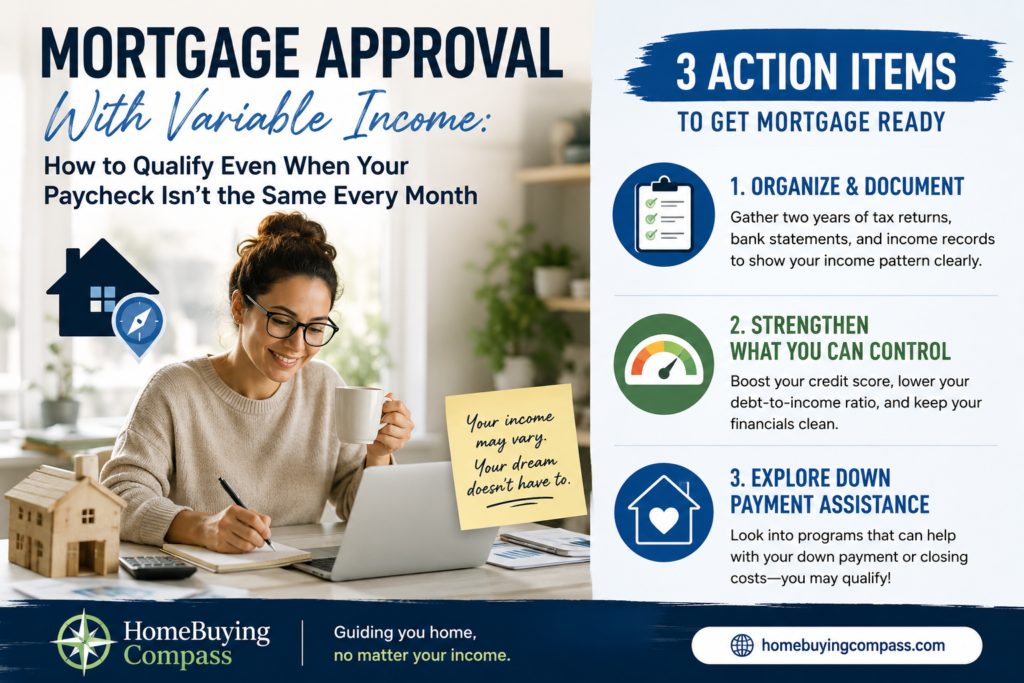
Step 1: Understand Which Loan Type Fits You Best
Not all mortgages work the same way, and this matters more than most people realize.
FHA loans are especially popular with first time home buyers because they allow lower credit scores and smaller down payments. They’re also more flexible with non-traditional income documentation than many conventional loans.
Conventional loans, on the other hand, may offer better long-term rates if your credit and income history are strong. However, they can be stricter about consistency.
So the truth is simple: there’s no universally “best” loan. There’s only the best loan for your specific income pattern. That’s exactly why talking to a lender early — even before you’re ready to buy — can save you months of stress later.
Step 2: Strengthen What You Can Control
You can’t force your income to look like someone else’s. But you can absolutely control the things lenders weigh heavily.
Boost Your Credit Score
Your credit score is one of the biggest levers you have. So paying down credit card balances and avoiding new debt in the months before you apply can noticeably improve your mortgage rates.
Keep Clean, Organized Records
If you’re self-employed or freelance, lenders want to see consistency on paper, even if your income isn’t consistent in real life. Therefore, clear books, categorized expenses, and accurate tax filings tell a much stronger story than bank statements alone.
Lower Your Debt-to-Income Ratio
Paying off smaller debts before you apply can significantly improve your approval odds. In fact, even eliminating one car payment or credit card balance can open doors.
Step 3: Don’t Overlook Down Payment Assistance
This is where so many first time home buyers give up too early.
Down payment assistance programs exist specifically to help people who don’t fit the “traditional” buyer mold. In fact, many are income-based, and some don’t even require repayment.
These programs can cover part of your down payment or closing costs, which often feels like the biggest barrier for someone with unpredictable income.
That’s exactly why so many people stay stuck renting longer than they planned — they simply never realized help was available.
Step 4: Prepare for Closing Costs Like a Pro
Closing costs catch almost everyone off guard, not just variable-income buyers.
Generally, closing costs run between 2% and 5% of the home’s purchase price. They usually include appraisal fees, title insurance, and lender fees.
So the buyers who feel calm at closing are the ones who planned for it early, not the ones scrambling the week before.
A Realistic Example
Picture Maria, a freelance graphic designer. Some months she earns $3,000. Other months, $7,000.
At first, she assumed no lender would take her seriously.
But after two years of consistent tax filings, a strengthened credit score, and a lender who specialized in self-employed buyers, she qualified for an FHA loan with a manageable down payment.
Her income never became “normal.” Instead, she simply learned how to present it in a way lenders could trust.
That’s the real skill here — not changing who you are, but understanding the process.
The Home Buying Process Doesn’t Have to Feel Like a Closed Door
If there’s one thing to take from this: variable income is not a disqualifier. Instead, it’s simply a detail lenders already know how to work with.
The buyers who succeed aren’t the ones with perfect paychecks. Rather, they’re the ones who stop assuming they don’t qualify and start asking the right questions.
You’ve worked hard to build the life and income you have, even if it doesn’t fit into a neat little box. So that effort counts for something. In fact, it counts for more than you think.
Homeownership doesn’t just belong to people with predictable paychecks. It belongs to people who show up, prepare, and keep moving forward.
That can be you. Starting now.
Frequently Asked Questions
Can I get approved for a mortgage with irregular income? Yes. Lenders typically look at a two-year average of your income rather than requiring a fixed monthly paycheck, especially for freelance, commission, or self-employed income.
What credit score do I need for an FHA loan with variable income? Many FHA loans allow credit scores as low as 580 with a 3.5% down payment, though requirements can vary by lender.
Do I need two years of tax returns to qualify? Most lenders request two years of tax returns for self-employed or commission-based buyers to establish an income pattern.
Is down payment assistance available for freelancers or self-employed buyers? Yes. Down payment assistance programs are usually based on income level and location, not employment type.
What percentage of the home price should I budget for closing costs? Closing costs typically range from 2% to 5% of the purchase price.
Disclaimer: This article is provided for general educational and informational purposes only and should not be considered legal, financial, tax, lending, investment, or real estate advice. Every home buying situation is unique. Before making any financial or legal decisions, consult with a licensed real estate agent, mortgage professional, real estate attorney, tax advisor, financial advisor, or other qualified professional who can provide guidance based on your individual circumstances.